The scoring bottleneck isn’t your scanner. It’s the expert time behind it.
DataTorch is the review-and-AI layer for imaging labs. It reads the files your capture system already produces, renders multi-channel data the way your specialists need to see it, and puts your own models in front of the easy cases, so expert hours go to the hard ones.
Keep the stack you already validated.
DataTorch does not acquire images and does not write your reports. It sits between the two, on the files your capture system already writes to storage you control, so adding it does not disturb the instruments, the workflow, or the validation work behind them.
Yours
Your scanner and capture software
1
Connect
Point DataTorch at the storage your scanner already writes to: S3, Azure, or Google Cloud. Images are read in place.
2
Render and review
Multi-channel images open with per-channel control, and your saved lookup curves so every reviewer sees the same signal.
3
Model first pass
Your own classifiers score first from a pipeline step, on your compute. A cytogeneticist confirms or corrects.
4
Export
Reviewed work leaves as COCO, YOLO, or JSON, or through the API, into your records and into your next training run.
Yours
Your reporting and records
Images a general tool renders flat.
Multi-channel, per channel
Open multi-channel files and tune each channel on its own, including files other viewers return blank.
Create your own schemas
Build the label hierarchies and scoring fields yourself, shaped to the SOP your lab already runs.
Your models in the loop
First-pass inference from your own classifiers, running on your own compute.
Roles & permissions
Org, team, and project-level access control over who can see and change what.
Imaging
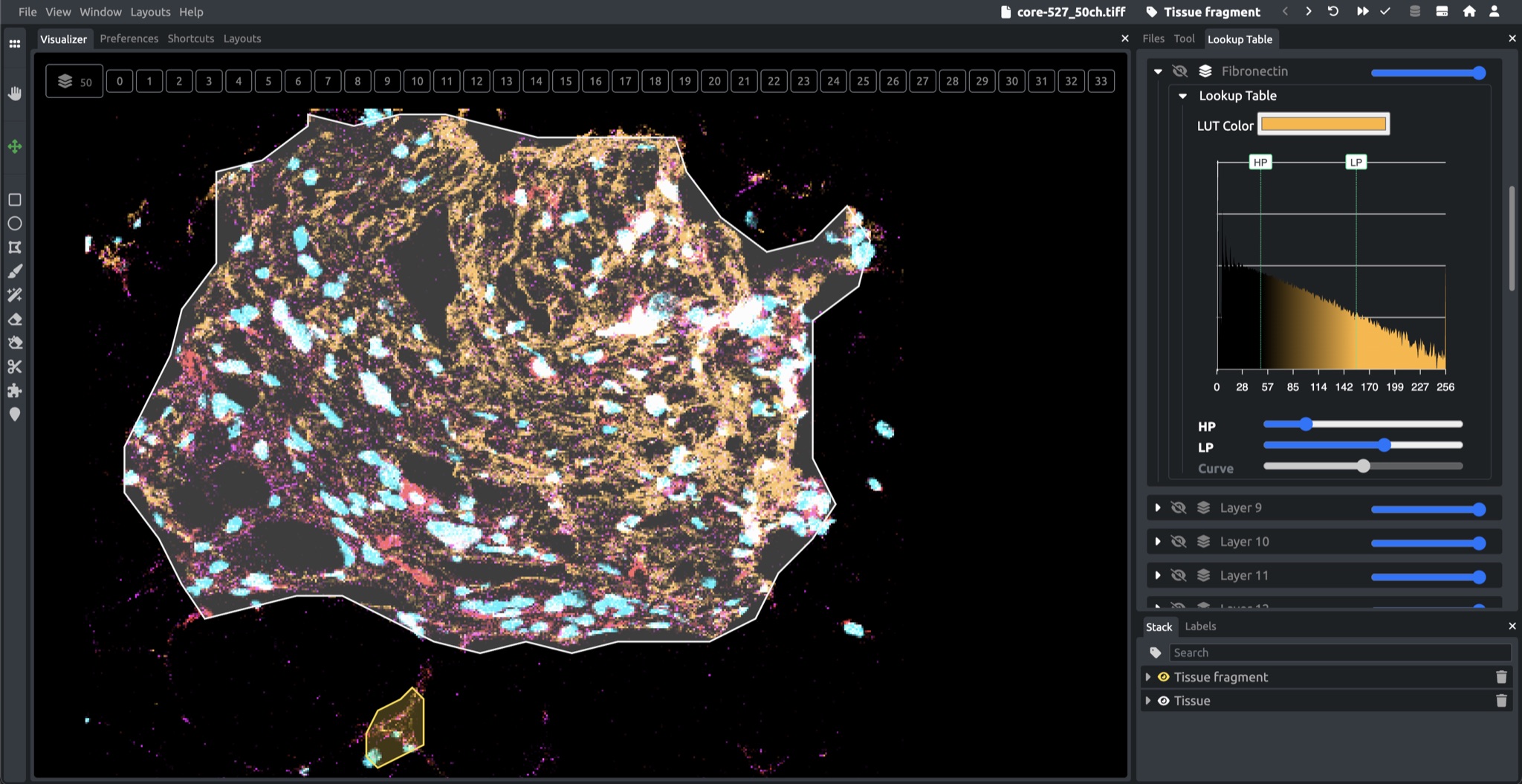
Every channel, under your control.
Multi-channel files open with each channel on its own, including high-bit-depth and oversized images other viewers return blank. A fifty-channel image renders smoothly in the browser. Tune each channel's lookup curve until the signal reads the way the assay needs it to.
One image, read the same way twice
Save those curves once on the project and every reviewer opens the image with the same settings, so a second specialist is looking at what the first one saw, not at their own contrast.
Expert review
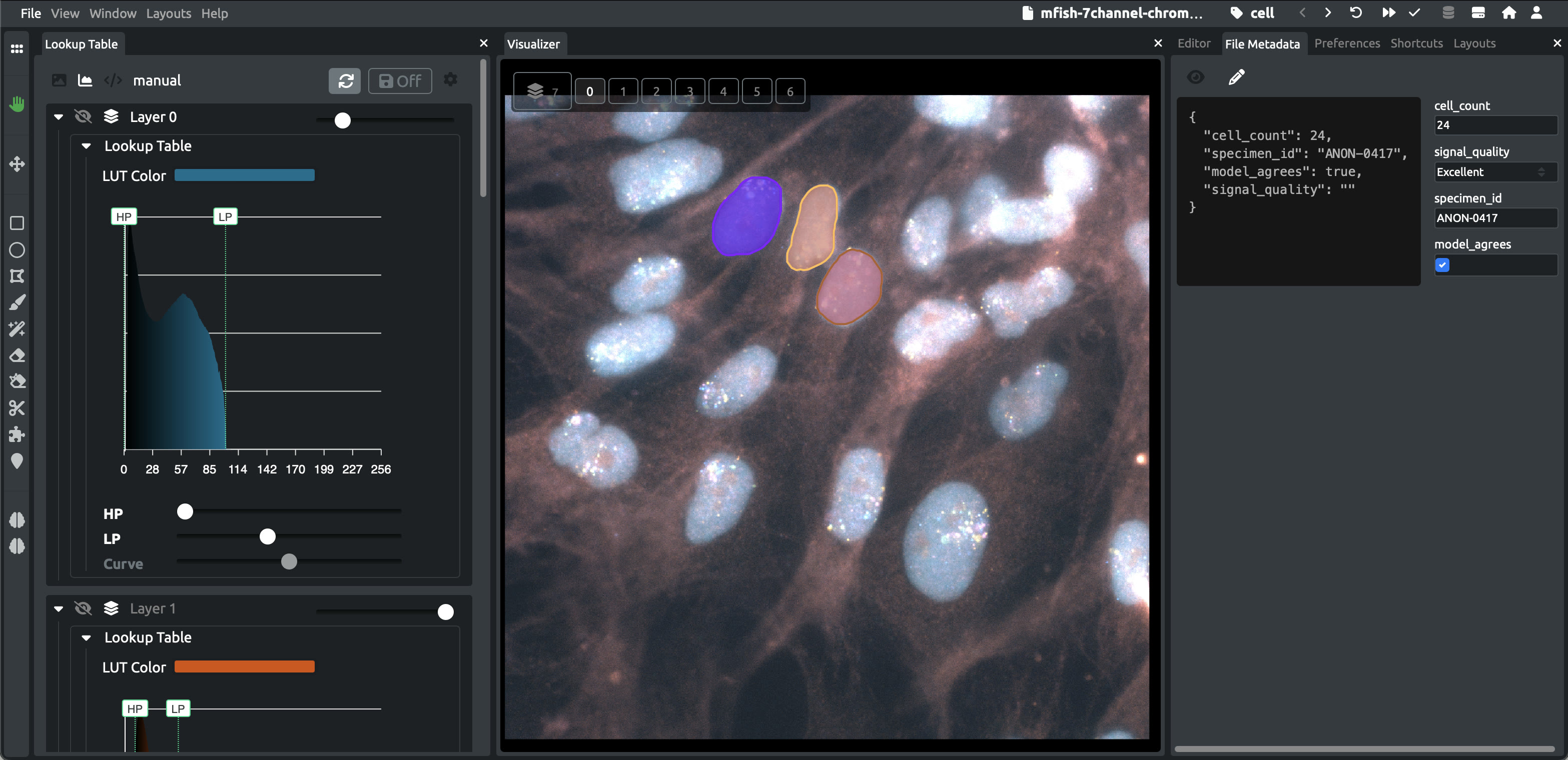
The model's call is already on screen when they open the case.
Scoring fields follow the protocol your lab already runs, and the prediction lands beside the assay image so your specialist confirms or corrects in one click rather than starting from a blank form. Reviewers pick up assigned work from a project task inbox, and every step records who submitted what, with its run log retained.
Sample image: idr0123 (Mota et al.), Image Data Resource, CC BY 4.0. Specimen identifiers shown are synthetic.
Your models
Your models score first.
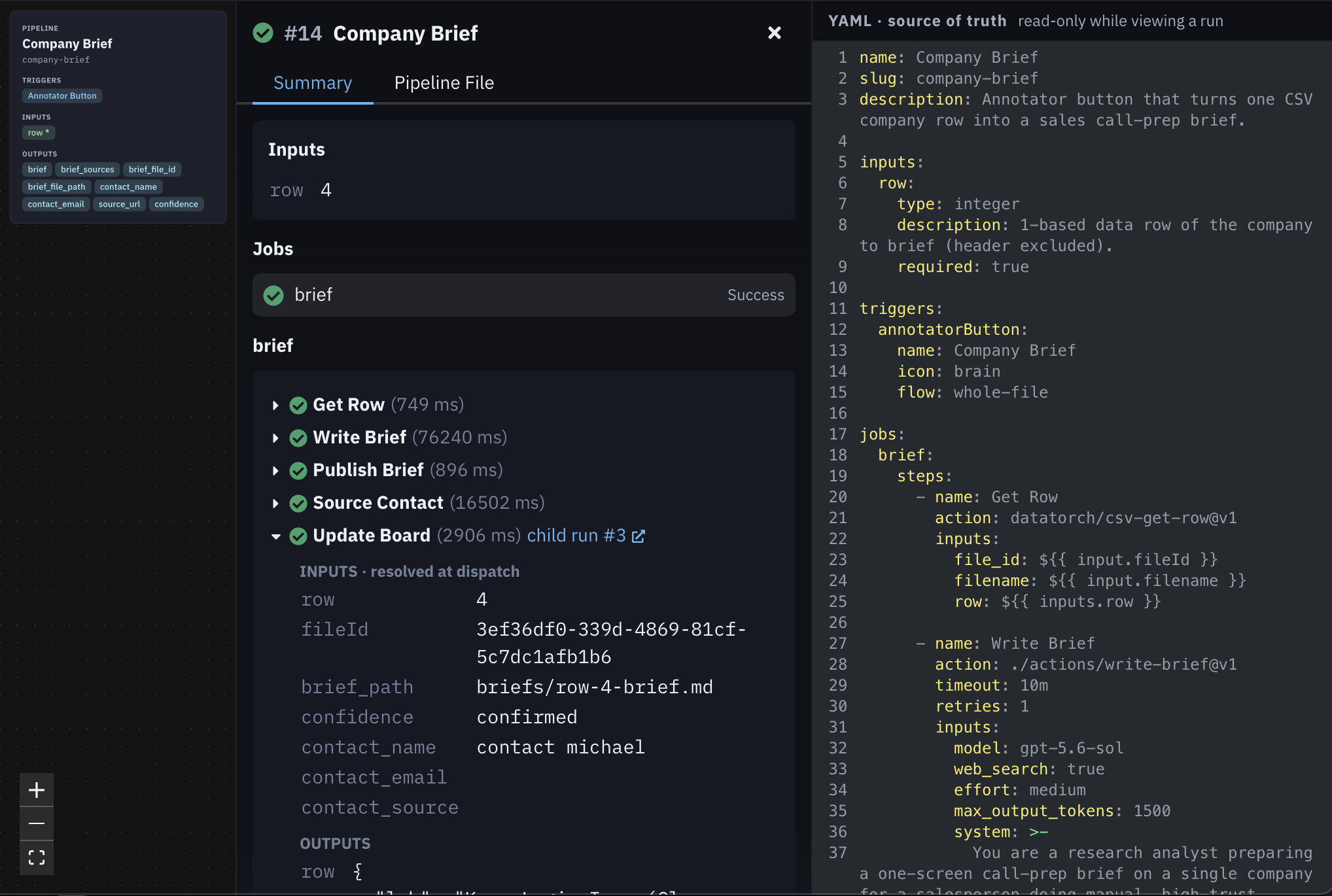
Wrap your own classifiers as Agents and wire them into a pipeline for first-pass inference. They run on your compute (your weights and your images never go to a vendor model), and the output surfaces in the normal review flow for a specialist to confirm. Every case they confirm adds to the labelled set your next training run uses.
When a result is questioned, the record answers.#
Lab work gets re-examined: by a customer, an auditor, or your own QA, sometimes months later. DataTorch journals every annotation write as it happens and closes review with a sign-off that locks the dataset, so “who scored this, and when?” is a lookup, not a reconstruction from memory.
An append-only audit log
Every annotation, label, and file-metadata write is journaled by database triggers: actor, action, timestamp, and the full before-and-after image. No write path skips it, and the log itself refuses edits.
Sign-off that locks
When scoring is complete, a reviewer signs the dataset off. It pins that instant and locks the dataset against edits, and unlocking to amend goes on the record too.
Versions you can return to
Cut a named version at any milestone. It pins the exact annotation state and label definitions at that instant, reconstructable on demand: the set you trained on, the set you delivered.
Branches for re-scoring
Re-score under a revised protocol on a branch while the signed-off set stays untouched. Then diff the branch against its base and merge what your reviewers accept.
Data control
Nothing leaves your infrastructure.
The questions your IT and quality teams will ask first, answered without hedging.
Your bucket, your credentials
Connect your own S3, Azure Blob, or Google Cloud Storage. DataTorch reads the images in place. They are never copied into a vendor bucket.
Your models, your hardware
Model agents run as Python on compute you control. Your weights and your images never reach a third-party model.
Hosted, your cloud, or no network at all
Run on our hosted cloud, deploy the same product into your own cloud, or install it fully air-gapped via Helm with an offline signed license.
Your data stays portable
Annotations export to COCO, YOLO, or JSON, and the GraphQL API and Python SDK reach every project, so the work is yours to take elsewhere.
DataTorch is not a certified or validated system, and it does not replace your quality process. It is built to run inside the environment your quality team already controls: on your hardware, against your storage, with no outbound path for your images. We’ll go through the specifics with your team on a call.
See it on your own images.
Start with a free private project, or book a demo to discuss your team’s images and review workflow.
datatorch@datatorch.io · we reply within a business day

Tools and community for image annotation: label, review, and share datasets, from everyday photos to the imagery only specialists can read.
© 2026 DataTorch. All rights reserved.